
“That Your Way May Be Known on Earth, Your Salvation Among All Nations” Psalm 67:2a
Dear IPC Family,
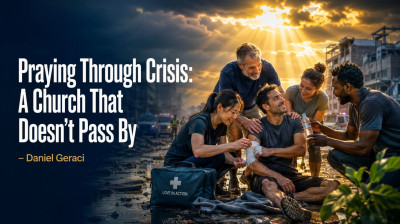
What a privilege it is to share what the Lord has been revealing to me concerning IPC’s fifth prayer focus, “Praying through Crisis.” As we pray for those who are suffering, it is natural to ask God for immediate relief. Yet the Lord is inviting the Church to adopt an expanded, strategic posture in crisis: to not only meet urgent needs but to embody God’s goodness so powerfully as His united and prepared Church that lives are rescued spiritually and communities are transformed. If the Church unites in this understanding and prays and acts accordingly, it can change cities and nations and draw multitudes into the Kingdom of God.
Jesus’ parable of the Good Samaritan (Luke 10:25–37) gives us a vivid framework for this calling. In that story, there are four key roles that define the spiritual dynamics of crisis: the thieves who create the crisis, the victim who is vulnerable, the religious bystanders who pass without reflecting God’s compassion, and the Samaritan who stops, cares for, and walks with the injured man until he recovers. The presence or absence of the Church is decisive: thieves represent the spiritual forces that seek to steal, kill, and destroy (John 10:10), and the way the Church responds will either reveal God's character or allow the enemy to gain ground.
There are several convictions I believe the Lord wants us to hold concerning crisis ministry. First, when someone is in crisis, the goodness of God is on trial. Those who suffer often face the question, “If God is loving, why would He allow this?” Unbelievers may walk away bitter and confused; believers may be tempted to doubt God’s care. Second, crises expose the enemy’s intent to destroy people and to wage war over souls. Third, the true Church is called to “make His ways known on the earth” by revealing God’s goodness to those who are hurting; when the religious community ignores the suffering, it can appear as if God doesn’t care. Fourth, spiritual rescue is ultimately the Church’s calling; while governments and agencies can provide practical assistance, only the Church can bring the Gospel and spiritual restoration.
Psalm 67:2 declares the role of His Church – that His way may be known on the earth. If the Church fails to show up in crisis, the narrative about God is authored by suffering itself or by secular responders; a person may be physically restored yet spiritually lost because no one made Him known or shared the Gospel. Romans 2:4 reminds us that “the goodness of God leads people to repentance.” In meaningful crisis ministry, provision and presence lead to Gospel conversations and transformed lives.
Consider Matthew 25:31–46, where Jesus identifies one measure of faithful communities: care for those who are hungry, thirsty, naked, sick, or strangers. When the Church shows up in tangible compassion, the gates of hell do not prevail because God’s goodness is revealed. Conversely, where the Church is absent, broken communities and “goat nations” are formed—places where need goes unmet and spiritual darkness takes root. The tragic cost is eternal: how many souls have been lost because a religious community passed by, trusting secular systems to do what only the Body of Christ can do?
Many churches today are divided and lack a structure for crisis response, assuming “someone else will handle it.” This mindset leaves people vulnerable to the enemy and forfeits opportunities to demonstrate Christ’s love. The Lord is calling us to a different posture: to be united, prepared, and trained so that, when crises strike, a ready Church responds as the Good Samaritan—tending wounds, meeting needs, and intentionally sharing the hope of the Gospel while walking with people until they are restored.
How can we pray?
First, pray that pastors would no longer be just friends but also partners, forming crisis-response church networks within their communities.
Second, pray for the church to become trained and equipped to walk with survivors until they are back on their feet, meeting their emotional, spiritual, and physical needs.
Third, pray for the Church to have compassionate hearts that will not walk by, discernment to identify the spiritual need behind physical suffering, and boldness to share the Gospel and make disciples with gentleness and truth.
 Fourth, also pray for protection for those serving in crises and for wisdom in coordinating with civil agencies without surrendering the Church’s unique mission.
Join me in this prayer:
‘Father, may every church in every city be united and ready for crisis,
so Your way may be known on the earth,
and Your salvation to the nations.’
With humble expectation,
Daniel Geraci – CEO
United in Crisis
DOWNLOAD THIS ARTICLE Daniel Geraci is the CEO and Founder of United in Crisis (UIC). UIC is a global training organization dedicated to uniting and equipping churches to form local crisis-response church networks that address the emotional, spiritual, and physical needs of those affected by crises. UIC is a partner and a practical expression of IPC’s mission. https://unitedincrisis.org


Crosswinds Prayer Trust was founded in 1994, at Nailsea, near Bristol in the South-west of England by Canon John Simons. Its aim is to mobilise, inform, connect and equip people in Christian Prayer...
Crosswinds
20 Sunningdale Road
Worle
Weston-super-Mare
North Somerset
BS22 6XP
Director: +44 (0) 1934 - 235777